Synctail

PRoblem
PRoblem
Why Pet Health Decisions Are So Hard to Get Right
Pet caregivers struggle to recognize subtle health changes in time—especially deciding how serious the situation is and whether a vet visit is necessary. Because pets cannot speak, caregivers are forced to rely almost entirely on visible behaviors and personal interpretation.
Beyond observing behavior, there is no clear, reliable standard to assess what these changes actually mean. Even though pet health requires more careful attention precisely because animals cannot communicate pain, caregivers often lack awareness and support to manage health proactively.
Pet caregivers struggle to recognize subtle health changes in time—especially deciding how serious the situation is and whether a vet visit is necessary. Because pets cannot speak, caregivers are forced to rely almost entirely on visible behaviors and personal interpretation.
Beyond observing behavior, there is no clear, reliable standard to assess what these changes actually mean. Even though pet health requires more careful attention precisely because animals cannot communicate pain, caregivers often lack awareness and support to manage health proactively.
solution
solution
Turning Subtle Signals into Clear Decisions
Existing pet care apps are often designed around the assumption that caregivers will continuously monitor the screen. Synctail challenges this assumption by proposing a personalized healthcare system in which a trusted AI monitors a pet’s health alongside the caregiver, intervening only when action is needed—even without constant attention.
By translating physiological, physical data into caregiver-friendly signals rather than raw metrics, Synctail enables early detection of abnormal patterns and supports timely action within the critical window of care.
Existing pet care apps are often designed around the assumption that caregivers will continuously monitor the screen. Synctail challenges this assumption by proposing a personalized healthcare system in which a trusted AI monitors a pet’s health alongside the caregiver, intervening only when action is needed—even without constant attention.
By translating physiological, physical data into caregiver-friendly signals rather than raw metrics, Synctail enables early detection of abnormal patterns and supports timely action within the critical window of care.
Project Type
Project Type
Team project -
2 Designers
Team project -
2 Designers
Duration
Duration
7 weeks
7 weeks
My Role
My Role
Research
BI Design
Design System
Prototyping
Visual Design
UI Design
Interaction Design
Usability Testing
Research
BI Design
Design System
Prototyping
Visual Design
UI Design
Interaction Design
Usability Testing
Background
Background
It Started With the Feeling That I Could Have Done More
Losing my dog of 13 years made me realize how easily subtle health signals can be missed. That experience led me to think about the need for a system that helps pet owners stay aware of changes in their pet’s condition.
Today, as more people care for pets, many face similar uncertainty and anxiety.
Synctail aims to ease that burden by helping owners better understand their pet’s condition and make more confident decisions around care.
Losing my dog of 13 years made me realize how easily subtle health signals can be missed. That experience led me to think about the need for a system that helps pet owners stay aware of changes in their pet’s condition.
Today, as more people care for pets, many face similar uncertainty and anxiety.
Synctail aims to ease that burden by helping owners better understand their pet’s condition and make more confident decisions around care.

Drag to explore the moments😊 →


Core Challenge
Core Challenge
How might we support pet owners in identifying important health signals without missing the subtle changes in their daily lives?
How might we support pet owners in making confident decisions without missing important signals?
Final Preview
Bringing Clarity into the Final Experience
The final designs reflect insights from research, testing, and iteration, translating them into a clear and supportive user experience. Each screen was designed to guide users through health decisions with confidence and minimal uncertainty.
Final Preview
Bringing Clarity into the Final Experience
The final designs reflect insights from research, testing, and iteration, translating them into a clear and supportive user experience. Each screen was designed to guide users through health decisions with confidence and minimal uncertainty.

Final Design Preview
Empathize
1-1 secondary research
1-1 secondary research
Understanding Today’s Pet Care Reality
This research was motivated by a personal experience in which I failed to recognize subtle warning signs in my pet’s condition at an early stage. To verify whether this challenge was systemic, we conducted secondary research across medical industry reports, n academic papers and n related articles.
This research was motivated by a personal experience in which I failed to recognize subtle warning signs in my pet’s condition at an early stage. To verify whether this challenge was systemic, we conducted secondary research across medical industry reports, n academic papers and n related articles.
Key findings 01_Market analysis
Key findings 01_Market analysis
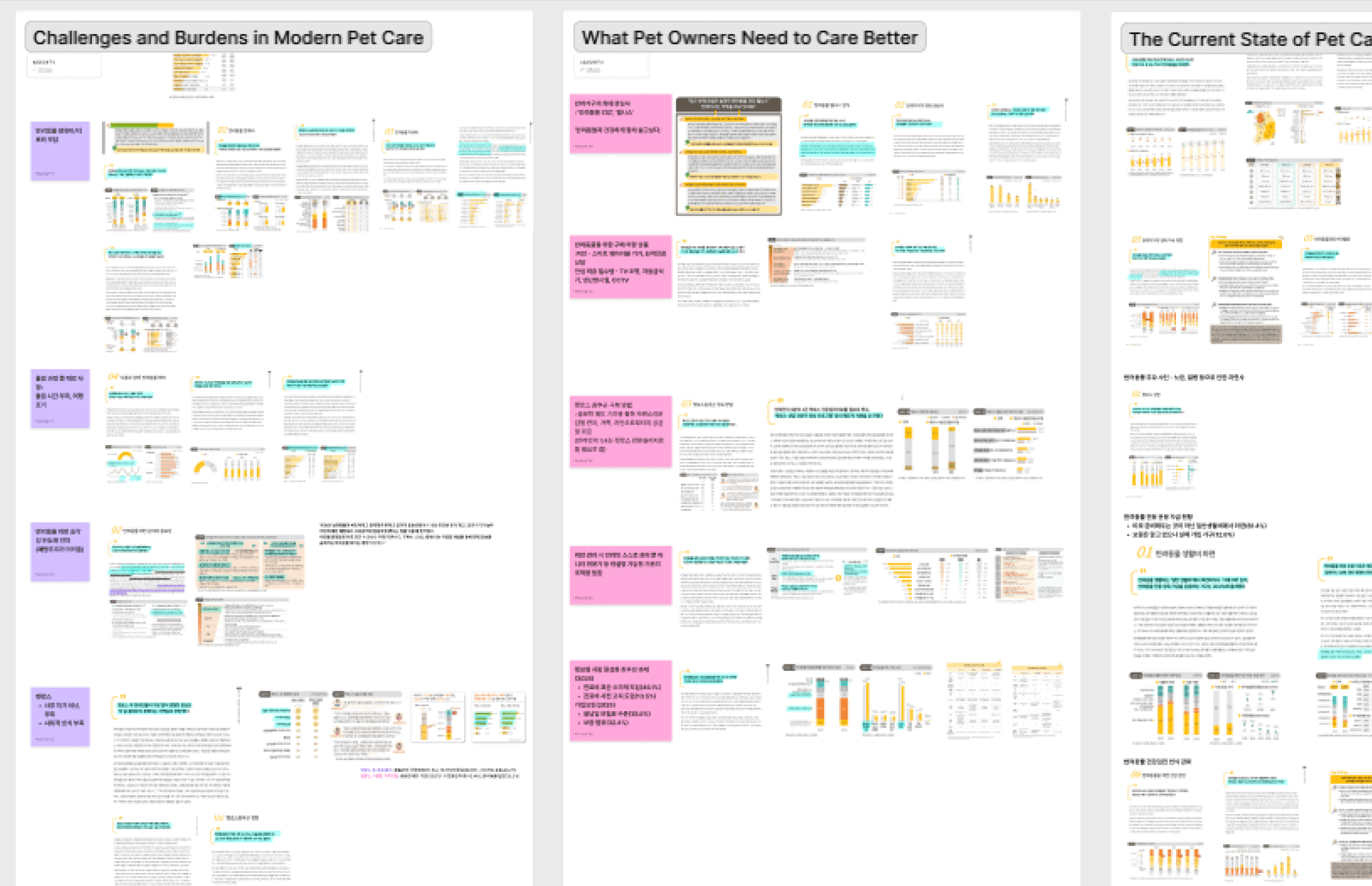
The Pet Care Market Has Expanded Faster Than Decision Support
We reviewed 8 academic papers and over 20 articles and found that pet care today focuses a lot on noticing problems early. However, many caregivers still feel unsure about when they should take their pet to the vet, showing a gap between having information and knowing what to do.
References: Springer, S. (2024). Does “Dr. Google” improve discussion and decisions in veterinary care? Yusuf, H., et al. (2024). Expanding access to veterinary clinical decision support.
We reviewed 8 academic papers and over 20 articles and found that pet care today focuses a lot on noticing problems early. However, many caregivers still feel unsure about when they should take their pet to the vet, showing a gap between having information and knowing what to do.
References: Springer, S. (2024). Does “Dr. Google” improve discussion and decisions in veterinary care? Yusuf, H., et al. (2024). Expanding access to veterinary clinical decision support.
Market Analysis
Key findings 02_competitor research
Key findings 02_competitor research
Apps Can Watch Pets, but Don’t Explain What’s Wrong
Competitor analysis revealed that most pet care solutions focus on camera-based monitoring yet provide limited support in helping owners easily interpret or summarize health signals. This led us to recognize a gap between monitoring pets and supporting how owners actually care for them.
Competitor analysis revealed that most pet care solutions focus on camera-based monitoring yet provide limited support in helping owners easily interpret or summarize health signals. This led us to recognize a gap between monitoring pets and supporting how owners actually care for them.

Competitor Research
At this point...
At this point...
Pet care tools and information have increased, but they rarely help caregivers decide what to do or when to act. This made us realize that the real problem is not a lack of information, but knowing what it means.
We wanted to closely look what information caregivers rely on and how they make decisions in real-life care situations.

1-2 primary research_user survey
1-2 primary research_user survey
When Do Caregivers Decide It’s Time to Act?
Today, there is a lot of information about pet health, but it doesn’t always help caregivers decide what to do. Through this survey, we wanted to learn which signs caregivers rely on most and what makes them hesitate, even when information is available.
We surveyed 13 pet owners with 34 questions to better understand these decision patterns in everyday pet care. Survey results showed that many caregivers decide based on what they can see, wait when signs are unclear, and want help deciding what to do.
Today, there is a lot of information about pet health, but it doesn’t always help caregivers decide what to do. Through this survey, we wanted to learn which signs caregivers rely on most and what makes them hesitate, even when information is available.
We surveyed 13 pet owners with 34 questions to better understand these decision patterns in everyday pet care. Survey results showed that many caregivers decide based on what they can see, wait when signs are unclear, and want help deciding what to do.
92.3% of users rely on intuitive signals—such as facial expressions and behavior—to read their pet’s condition.
Survey Result 01
Behavior-Based Judgment Dominates Pet Care Decisions
Pet Owners’ Key References in Condition Judgment
Intuitive Signals
92.3%
Medical
Consultation
53.8%
Community
Advice
23.1%
46.2% of users experienced delayed care or struggled to identify what help was needed.
Survey Result 02
Uncertainty About Symptoms Delays Vet Visits
Types of Challenges Faced in Care Situations
Emotional Exhaustion
38.5%
Care Delayed by Misread Signs
Unsure What to Do
46.2%
77.8% of users want technology that provides evidence-based support for their decisions.
Survey Result 03
Pet Owners Want Help Deciding,
Not More Data
Technologies That Support Better Care Decisions
Evidence-based insights for decisions
77.8%
Reduces the emotional burden during care
44.4%

1-3 primary research_In-depth interview
1-3 primary research_In-depth interview
Why do caregivers continue to rely on intuition,
even when they know it can be wrong?
Why do caregivers continue to rely on intuition, even when they know it can be wrong?
While the survey showed what caregivers do when making care decisions, it did not fully explain why these patterns persist. We wanted to understand what caregivers are thinking and feeling at the moment of decision—what they are weighing or waiting for before taking action. To uncover this deeper context, we conducted in-depth interviews with 6 survey participants and analyzed recurring themes using Thematic Analysis.
While the survey showed what caregivers do when making care decisions, it did not fully explain why these patterns persist. We wanted to understand what caregivers are thinking and feeling at the moment of decision—what they are weighing or waiting for before taking action. To uncover this deeper context, we conducted in-depth interviews with 6 survey participants and analyzed recurring themes using Thematic Analysis.

Interview in Progress(2 users)

Thematic Analysis
From our research, we saw clear patterns in where pet care decisions begin to break down.
Based on these patterns, we identified three key pain points and three corresponding needs.
From our research, we saw clear patterns in where pet care decisions begin to break down. Based on these patterns, we identified three key pain points and three corresponding needs.
We found where pet care decisions start to break down :
We found where pet care decisions start to break down :
Painpoints #1
Pet Care Based on Gut Feeling
Caregivers trust their intuition and do nothing, which often means early warning signs are missed.
Painpoints #2
High Vet Costs Delay Timely Care
Going to the vet every time a pet seems sick is expensive, so caregivers feel a strong financial burden, which often leads to delayed care.
Painpoints #3
Uneven Responsibility Delays Decisions
Co-caregivers don’t feel the same level of worry, so they can’t agree on what to do for the pet, and care gets delayed.
So, what do users need to make clear, timely pet care decisions?
So, what do users need to make clear, timely pet care decisions?
Needs #1
Data-based evidence to support decisions
Caregivers need clear data they can trust, instead of guessing based on how the pet looks.
Needs #2
Clear, actionable guidance for timely response
Caregivers need simple steps that tell them what to do and when to act.
Needs #3
A shared, objective standard to align caregivers
Caregivers need a shared guidance so everyone can agree on the same decision.
Define
2-1 problem statement
2-1 problem statement
Across different pain points, we kept seeing the same issue in how pet care decisions are made
Our research shows that the core challenge in pet care lies in decision-making. Without clear judgment criteria, owners rely on intuition, which increases emotional burden and places full responsibility on the individual.
Our research shows that the core challenge in pet care lies in decision-making. Without clear judgment criteria, owners rely on intuition, which increases emotional burden and places full responsibility on the individual.
Problem Statement
Because there is no clear way to decide what to do when pets show small changes, caregivers are left to handle the decision alone, carrying all the worry and often missing the right moment to help.
Because there is no clear way to decide what to do when pets show small changes, caregivers are left to handle the decision alone, carrying all the worry and often missing the right moment to help.
2-2 Persona & User Journey map
2-2 Persona & User Journey map
To understand pet care pain points in context, we looked at two opposite types of users
We identified two recurring decision-making contexts in pet care: individual decision-making driven by personal interpretation, and shared care situations where differing judgments delay action. Two personas were defined to represent these contexts and their distinct decision structures.
User journey maps helped us move beyond static personas to reveal where intuition-driven judgments lead to delayed pet care decisions.
We identified two recurring decision-making contexts in pet care: individual decision-making driven by personal interpretation, and shared care situations where differing judgments delay action. Two personas were defined to represent these contexts and their distinct decision structures.
User journey maps helped us move beyond static personas to reveal where intuition-driven judgments lead to delayed pet care decisions.

Meet Laura
Laura is a young woman living alone and caring for her senior dog who is sick and needs treatment. She wants clear signs to know when to go to the vet and when it is okay to wait.
Laura is a young woman living alone and caring for her senior dog who is sick and needs treatment. She wants clear signs to know when to go to the vet and when it is okay to wait.


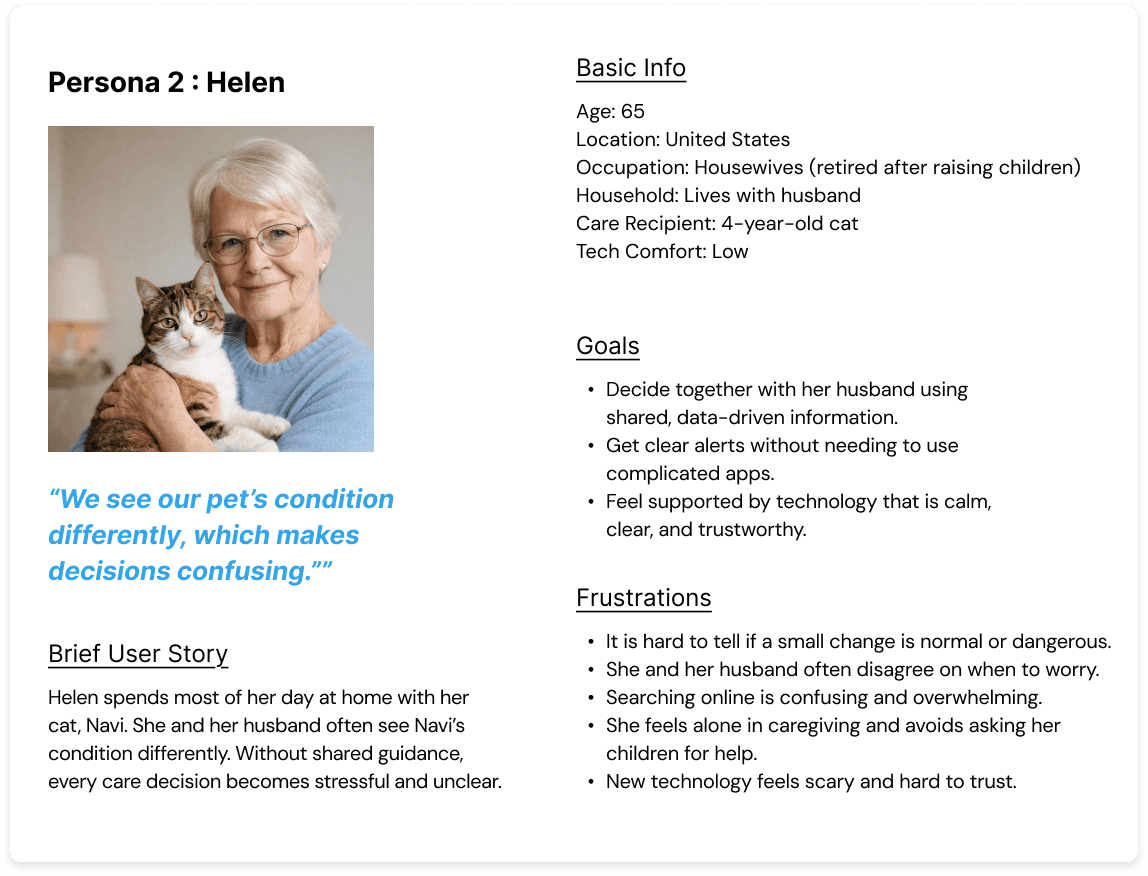
Meet Helen
Helen is a retired woman who stays at home and takes care of her cat with her husband. She wants simple and clear help to make care decisions when she and her husband think differently.
Helen is a retired woman who stays at home and takes care of her cat with her husband. She wants simple and clear help to make care decisions when she and her husband think differently.

Laura’s Jouney
Laura notices small changes in her senior dog but struggles to decide how serious they are. High vet costs and unclear signals make her hesitate between waiting and acting.
Laura notices small changes in her senior dog but struggles to decide how serious they are. High vet costs and unclear signals make her hesitate between waiting and acting.

Helen’s Jouney
Helen and her husband interpret their cat’s condition differently, which slows down decisions. Without shared, trusted guidance, care decisions become stressful and delayed.
Helen and her husband interpret their cat’s condition differently, which slows down decisions. Without shared, trusted guidance, care decisions become stressful and delayed.
Ideate
3-1 brainstorming
3-1 brainstorming
Opening up all possibilities to turn gut feelings into clear decisions
Based on the 8 key pain points and needs identified in the Define phase, we conducted a brainstorming session with the team to expand solution ideas.
Based on the 8 key pain points and needs identified in the Define phase, we conducted a brainstorming session with the team to expand solution ideas.
Function exploration
Reviewing existing technologies to find what could truly support clearer care
Our review highlighted the need for features that provide reliable pet health data for clearer decision-making. We therefore explored existing technologies(cameras, microchips, facial emotion analysis) and found that such features are already feasible using current sensor, behavioral tracking.

Feasibility Analysis
Feasibility Analysis

Feasibility Analysis
Function exploration
Reviewing existing technologies to find what could truly support clearer care
Our review highlighted the need for features that provide reliable pet health data for clearer decision-making. We therefore explored existing technologies(cameras, microchips, facial emotion analysis) and found that such features are already feasible using current sensor, behavioral tracking.
Feasibility Analysis
Feasibility Analysis
Feasibility Analysis
ideation
ideation
Exploring User-Centered Solutions from Scattered Pet Care Decision Problems
Our team brainstormed together, organizing ideas into cards and grouping them to explore common directions, resulting in 23 ideas.
Our team brainstormed together, organizing ideas into cards and grouping them to explore common directions, resulting in 23 ideas.

Brainstorming
3-2 impact effort matrix
3-2 impact effort matrix
Narrowing Ideas Down to Low-Effort, High-Value Solutions
Narrowing Ideas Down to Low-Effort, High-Value Solutions
Among the ideas generated during brainstorming, we organized potential MVP features into a 2×2 Impact–Effort Matrix. Prioritization was guided by how effectively each idea addressed users’ core pain points, with repeated evaluation across the team. Through this process, we identified solutions that balanced feasibility with their potential to meaningfully reduce user anxiety.
Among the ideas generated during brainstorming, we organized potential MVP features into a 2×2 Impact–Effort Matrix. Prioritization was guided by how effectively each idea addressed users’ core pain points, with repeated evaluation across the team. Through this process, we identified solutions that balanced feasibility with their potential to meaningfully reduce user anxiety.
Brainstorming

Prioritization

Final Selection
3-3 low-fi
3-3 low-fi
Defining Screen Structure Through Low-Fi Sketches
To validate whether the features organized in the IA could be clearly understood at the screen level, we began with low-fidelity sketches. These sketches helped us assess whether users could quickly recognize key functions and follow the intended flow without confusion. We gathered feedback from others and iterated on the layouts twice with the team to further refine the screen structure.
To validate whether the features organized in the IA could be clearly understood at the screen level, we began with low-fidelity sketches. These sketches helped us assess whether users could quickly recognize key functions and follow the intended flow without confusion. We gathered feedback from others and iterated on the layouts twice with the team to further refine the screen structure.

Low-fi Sketch
3-4 flow chart
3-4 flow chart
Identifying Edge Cases Through User Flow Validation
To evaluate the experience from the user’s perspective, we used user flow charts to validate interaction flows and identify potential gaps. This process allowed us to define edge cases in advance and ensure continuity across different scenarios.
Given the healthcare context, we also defined an alert policy to avoid causing unnecessary anxiety and reviewed notification scenarios across various usage conditions.
To evaluate the experience from the user’s perspective, we used user flow charts to validate interaction flows and identify potential gaps. This process allowed us to define edge cases in advance and ensure continuity across different scenarios.
Given the healthcare context, we also defined an alert policy to avoid causing unnecessary anxiety and reviewed notification scenarios across various usage conditions.

Flow Chart_Daily
Prototype
4-1 wire frame
4-1 wire frame
Wireframing for Design–Development Alignment
To ensure smooth collaboration with the development team, we created wireframes for Synctail’s key screens based on low-fidelity sketches and flowcharts.
We also documented screen structures and interaction flows in detailed screen specifications, aligning the team around a shared understanding and enabling faster implementation of the final designs.
To ensure smooth collaboration with the development team, we created wireframes for Synctail’s key screens based on low-fidelity sketches and flowcharts.
We also documented screen structures and interaction flows in detailed screen specifications, aligning the team around a shared understanding and enabling faster implementation of the final designs.

Home Screen Before / After

Notification Before / After

Category Details Screen Before / After
4-2 Design System
4-2 Design System
Establishing Visual Consistency and Scalability
To ensure consistency across screens and support scalable design, we defined a design system including color tokens, typography, components, and interaction principles. This system helped align design decisions across the product and enabled efficient collaboration with developers.
To ensure consistency across screens and support scalable design, we defined a design system including color tokens, typography, components, and interaction principles. This system helped align design decisions across the product and enabled efficient collaboration with developers.

Final Design
Feature 01_Story
Feature 01_Story
Check your Pet’s Health at a Glance
Designed to surface what matters today by organizing health signals into a clear, glanceable story.
Designed to surface what matters today by organizing health signals into a clear, glanceable story.


Feature 02_Category
Feature 02_Category
Dig Deeper into Pet Health Signals
Break down pet health into physical, sleep, cognitive, and bonding areas for deeper insight.
Break down pet health into physical, sleep, cognitive, and bonding areas for deeper insight.
Feature 03_AI coach
Feature 03_AI coach
Get Guidance for Pet Care Decisions
Interprets health signals and recent changes to suggest what to do next, from monitoring to vet visits.
Interprets health signals and recent changes to suggest what to do next, from monitoring to vet visits.
Test
5 testing
5 testing
Did This App Help Users More Confidently Decide When a Pet’s Condition Is Urgent or Safe to Wait?
We conducted a usability test with 4 pet owners, consisting of six tasks that covered the full user journey—from onboarding to the decision of whether to visit a vet. The goal was to evaluate whether the app meaningfully influenced caregivers’ decision-making by comparing changes in anxiety levels before and after using the app.
In addition to task performance evaluation, we collected quantitative feedback using the System Usability Scale (SUS). The results showed an average score of 85.6, indicating generally strong usability. However, qualitative feedback revealed key improvement areas: users felt there was insufficient support for persuading family members in shared decision-making contexts, and some screens lacked visual clarity, which caused moments of confusion during use.
We conducted a usability test with 4 pet owners, consisting of six tasks that covered the full user journey—from onboarding to the decision of whether to visit a vet. The goal was to evaluate whether the app meaningfully influenced caregivers’ decision-making by comparing changes in anxiety levels before and after using the app.
In addition to task performance evaluation, we collected quantitative feedback using the System Usability Scale (SUS). The results showed an average score of 85.6, indicating generally strong usability. However, qualitative feedback revealed key improvement areas: users felt there was insufficient support for persuading family members in shared decision-making contexts, and some screens lacked visual clarity, which caused moments of confusion during use.
Usability Testing

SUS Results : 85.6 (Excellent Usability)
Reflections
take aways
take aways
Data alone does not resolve uncertainty
While objective health metrics reduced anxiety, users needed contextual explanations and reassurance to feel confident acting on the information.
While objective health metrics reduced anxiety, users needed contextual explanations and reassurance to feel confident acting on the information.
Transparency builds trust more effectively than accuracy alone
Users showed higher confidence when they understood why a recommendation was made, not just what the recommendation was.
Users showed higher confidence when they understood why a recommendation was made, not just what the recommendation was.
Next steps
Next steps
Explore B2B extensions for professional pet
care ecosystems
Explore B2B extensions for professional pet care ecosystems
Investigate how Synctail’s decision-support model could support veterinarians, clinics, or pet care providers by enabling:
pre-visit health summaries to improve consultation efficiency
clearer communication between caregivers and professionals
Investigate how Synctail’s decision-support model could support veterinarians, clinics, or pet care providers by enabling: pre-visit health summaries to improve consultation efficiency clearer communication between caregivers and professionals
More Projects
